FoodRush is designed as a two player interactive arcade game that allows people to compete the right utensil to eat food. This game was exhibited in Wonderville, Brooklyn, New York on December 5 and 6, 2019.
FoodRush is designed as a two player interactive arcade game that allows people to compete the right utensil to eat food. This game was exhibited in Wonderville, Brooklyn, New York on December 5 and 6, 2019.
FoodRush is designed as a two player interactive arcade game that allows people to compete the right utensil to eat food. This game was exhibited in Wonderville, Brooklyn, New York on December 5 and 6, 2019.


ZHUYUAN HE
Life of the Mirrors
Mirrors play an important role in our daily lives. They are so prevalent and ubiquitous that sometimes they go unnoticed, and we are tempted to ignore the significance of how deeply they impact our identities, behaviors, and culture.

The Reflection

Echo and Narcissus
John William Waterhouse, 1903
Prior to the invention of the mirror, water was the best source of reflection for ancient people to see themselves. In China, people used bowls of water as mirrors, and the Chinese word 监 (literally "bowl") used to be used to refer to mirrors. Only after mirrors were made of metal did the word for mirrors change from 监 to 鉴, which includes the metal character (金).
Obsidian Mirrors

Obsidian mirror (found around 6000 BC) is made by volcanic glass, which is formed by quickly cooled lava.
Bronze Mirrors


Bronze mirrors were invented around 2000 BC, and it became popular and trendy in China. Sophisticated decorations on the back of mirror often represent good fortune and well wishes in Chinese culture.
A Dedicated Space for Woman
Other inventions associated with the mirror include the places to put and install mirrors. Almost every woman in China had dressing tables/boxes of different types and sizes. They not only held the mirror itself, but also included different drawers to keep cosmetics, brushes, and accessories. Some of the pictures below illustrate a wide range of dressing tables/boxes, going back to the Ming and Qing dynasties (1368 - 1912).


Religion,
Metaphor,
Superstition and Culture
Mirrors have tremendous influence on human history in terms of religion, art, and culture. Both in the western and eastern worlds, mirrors usually represent a mysterious and magical power. In China, a Ba Gua (八卦) mirror was initially used in front of families' door to scare away ghosts, but gradually it became a tradition that is still practiced in many places in China. In the west, mirror has been commonly used in divination. Earlier on, it also represents purity in the Bible. Many paintings during Renaissance used mirrors to imply chastity. Additionally, poets, dramatists, and writers often use mirrors as motifs and give them special meaning and important roles in their works.

Ba Gua Mirror

The Conversion Of The Magdalene, Caravaggio
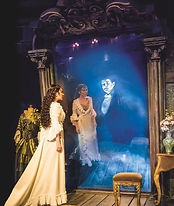

The Phantom of the Opera
Through the Looking Glass

The Modern Time
In 1835, German chemist Justus von Liebig invented a process for applying a thin layer of metallic silver to one side of a pane of clear glass. This method was soon adopted for the mass production of mirrors.
What We Have Today
2012
2016
2018
2018

Seraku's Smart Wash Basin
A Japanese company Seraku made an Android mirror that allows to display weather, time, temperature and user's weight, etc.

MIRROR
A fitness mirror that enables users to take cardio, yoga, workout classes while watching both instructors and themselves through the glass.
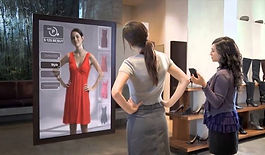
Amazon’s AR Mirror
This mirror allows users to try on different outfits in various virtual locations.

Alibaba's AR Makeup Mirror
This mirror allows customers to try on different lipstick, foundation, etc.
Thoughts and Myths
A lot of digital devices today have shapes and features very close to a mirror. Our phones, laptop, TV, tablets all have flat thin glass surfaces. It is unknown if there is any correlation between the design of mirrors and the design our current digital products, but a lot of us definitely enjoy the selfie mode of the phones and digital cameras that fulfills our desires to look at ourselves whenever we want and capture the permanent moment of our smiles into binary data.